The secondary ticket market is a private equity-backed $10 billion industry that profits by placing itself between artists and their fans. Here's what they don't want legislators to know.
Ticketmaster is a monopoly, that much is true, and it deserves scrutiny. Its real competitors are companies like AXS, Dice, Paciolan, and Etix: businesses that actually build ticketing infrastructure, serve venues, and compete for the right to sell tickets in the first place. Scalper marketplaces do none of that. They don't compete with Ticketmaster. Their only competitor is you, the fan, for the right to buy your seat before you do, and sell it back to you at a markup.
The secondary market presents itself as a consumer service. A closer look at its leadership reveals something different: a sophisticated financial operation, disclosed in federal filings, that profits at every level of the chain.
StubHub's holding company was incorporated under the name Pugnacious Endeavors, Inc. That's not a rumor, it's in the company's own IPO documents, filed with the SEC. The name says something about how this industry views the people it serves.
What those same documents reveal is more significant. Baker, as CEO of StubHub, is simultaneously the managing partner of Andro Capital, a fund that describes itself as a ticketing hedge fund, and that operates as an active ticket seller on StubHub's own platform. StubHub's S-1 discloses this conflict of interest in its Related Party Transactions section, where public companies are legally required to be transparent with investors. To raise capital for this fund, Baker operates the Andro Capital Cayman Feeder Fund, a vehicle registered in the Cayman Islands, one of the world's most opaque offshore financial jurisdictions.
The scale of this operation is not small. A member of Baker's own team described the fund on LinkedIn as having invested and traded $200 million across several geographies and currencies while returning mid-teens IRRs on ultra short duration, and noted that the operation built its own proprietary trading software to do it. This is not a side hobby. It is a sophisticated, multi-hundred-million-dollar financial enterprise built specifically to profit from the live events industry.
That contrast is the story. Publicly, Baker says StubHub exists to connect fans with live events. Privately, his own team's LinkedIn profiles describe a hedge fund trading hundreds of millions of dollars in ticket inventory, generating investment returns for offshore investors. One is the press release. The other is in the filings.
Baker also created Colloquy Capital LLC, described in the S-1 as "a financing and liquidity platform for professional ticket sellers." Under a five-year exclusive agreement, Colloquy provides short-term financing to scalpers who sell on StubHub, with a percentage of those sellers' proceeds flowing back to Colloquy, a company affiliated with Andro, which Baker controls.
In plain terms: the CEO of the platform runs an offshore-funded ticketing hedge fund that finances scalpers, lists their inventory on his own platform, and collects a share of their proceeds. This wasn't uncovered by an investigation. It was buried in a dense federal filing that nobody was meant to read carefully.
StubHub is also the subject of a civil RICO lawsuit accusing the company of knowingly advertising and brokering the sale of fraudulent tickets — a more serious set of allegations than the fee transparency suits the company has faced in the past. The RICO case goes to the question of whether StubHub knows the nature of the inventory on its platform and profits from it regardless.
Don Vaccaro is one of the most influential figures in secondary ticketing, and one of the most active in shaping New York's ticketing laws. He is the founder of TicketNetwork, one of the largest resale ecosystems in the country, and the founder of RCN Capital, which by his own public description lends money to ticket brokers to assist in purchasing inventory.
TicketNetwork settled a lawsuit with the Federal Trade Commission for $1.4 million and agreed to stop operating URLs designed to look like official venue websites, sites engineered to make fans believe they were buying directly from the source. That settlement did not end the practice.
Today, an estimated network of roughly 40 deceptive venue-spoofing sites continues to operate, all supplying ticket inventory traceable to Vaccaro's network. Sites like jonesbeach.com, fake venue lookalikes, and dozens of others are designed to appear as official sources. No one has been able to determine who legally owns these domains. The ownership is deliberately obscured through a network of offshore entities believed to operate out of the Seychelles Islands, one of the world's most secretive offshore jurisdictions. Companies like Pure Tonic Marketing, a Seychelles-based operation, specialize in building and operating exactly these kinds of fake venue websites. A New York fan searching for Jones Beach tickets may have no idea they've left the legitimate market, entered a deceptive site, and are paying a scalper premium on inventory that was never authorized by the venue.
TicketNetwork also reached a $1.55 million settlement with the New York Attorney General for misleading tens of thousands of New York customers into purchasing speculative tickets, tickets the sellers didn't yet possess, for concerts and live events.
The infrastructure that powers these deceptive venue URLs continues to operate, offshore and largely anonymous. The financing that fuels it flows through RCN Capital's loans to scalpers. And the lobbying influence that keeps it legal is directed squarely at Albany.
Vaccaro also owns TicketNews, a website that presents itself as an independent industry news publication. It is not. TicketNews is an industry promotional vehicle that publishes content favorable to scalper interests while presenting itself as neutral journalism. When scalper-backed organizations cite "industry reporting," TicketNews is frequently the source, and Vaccaro is frequently the owner.
Bots are the engine of the secondary market. Many scalper platforms claim to oppose them. That claim doesn't survive scrutiny.
The term "bot" is often misunderstood, it implies full automation, a machine running with no human involvement. But many of the tools scalpers use are better described as superpowers. They make a professional scalper bionic compared to a real fan: faster, running more sessions simultaneously, never mistyping a credit card number, never losing a checkout race. Some are fully automated. Many are human-assisted. All of them tilt the playing field in ways no fan can compete with.
Here's how it actually works: these tools hit ticketing platforms the moment a show goes on sale, harvesting large quantities of tickets before most fans have finished loading the page. Those tickets flow into B2B exchanges where professional scalpers buy them in bulk at low margins and high volume, then relist them on consumer-facing platforms at markups that fund the entire operation.
When a scalper says "we don't use bots," they may technically mean they didn't use fully automated software. But they are buying tickets that bot-assisted tools harvested. The distinction is designed to sound clean in legislative testimony. In practice, every scalper who sources inventory from these B2B exchanges is a downstream beneficiary, and customer, of these superpower tools. They are either unaware of where their inventory comes from, or complacent in supporting it. Neither is acceptable.
The industry term for bots sweeping a show's inventory is "liquidity." What it actually means is that a real fan sat at their computer on sale day, got nothing, and is now being asked to pay three times face value for a seat that was taken from them by a machine. The bots don't serve fans. They serve the scalpers who buy what the bots harvest.
Ticketmaster provides box office software and infrastructure. AXS builds access control systems. Independent promoters create the shows. Artists write the music, fund the production, and build the audience over years. Scalpers contribute nothing to the promotion, production, or execution of a live event. They arrive after every dollar of value has been created by others, insert themselves between the artist and the fan, and collect a tax on someone else's work.
Platinum tickets and dynamic pricing exist because scalpers were capturing the spread between an artist's intentionally accessible face value and what the secondary market could charge. The money flowing to scalpers was leaving the local music ecosystem, moving to offshore platforms and Cayman Island hedge funds, funding private jets and yachts instead of a better fan experience.
Dynamic and Platinum pricing are imperfect tools that arose as a direct response to that extraction. The money at least stays in the ecosystem and funds touring infrastructure and artist development. It's not ideal, but the cause isn't pricing strategy. The cause is the extraction that made artists feel they had to respond.
This isn't a guy with a few extra tickets. The secondary market runs on a sophisticated, purpose-built technology stack. Here is each tool in the chain, named, linked, and explained in plain language.
The word "bot" conjures an image of full automation, a machine running without human involvement. The reality is broader and more insidious. Many of the tools scalpers use are better described as superpowers: software that makes a professional scalper bionic compared to a regular fan. Auto-filled forms. Pre-loaded payment details. Dozens of simultaneous browser sessions. Checkout executed in milliseconds. A fan types their email address. A scalper with assist tools has already completed the purchase, ten times over.
Some operations are fully automated, running thousands of fake accounts with no human involvement at all. Others are human-assisted tools that simply give professionals a success rate no fan can match unaided. The distinction doesn't matter to the fan who couldn't get a ticket. Whether it's full automation or a bionic assist, the outcome is identical: the scalper wins, the fan loses, and the tickets flow to the resale market at markup.
In one documented case, a single ticket broker used 9,047 separate accounts on Ticketmaster to make 315,528 ticket orders to Hamilton and other popular events over two years. Ticketmaster reports blocking 200 million bot and assist attempts every single day. Tools like Multilogin are sold openly as this kind of infrastructure, advertising the ability to "manage thousands of ticketing accounts with automation." This is a commercial industry built specifically to give scalpers an unfair advantage over fans.
Beyond bots, an entire category of purpose-built web browsers exists specifically to give scalpers a speed and volume advantage over fans. Browsers like Insomniac Browser, Jancy, Browserjet, Stubtabs, and Primo Browser are not general-purpose tools. They are built from the ground up to harvest tickets.
Insomniac's own marketing describes a system where each "puller" (ticket buyer) can have hundreds of browser tabs open simultaneously, with dozens of managers overseeing hundreds of pullers at the same time. Managers can view every cart in real time and approve or deny each purchase before it goes through. This is not one person buying a few tickets. This is a supervised industrial operation running hundreds of simultaneous checkout sessions against the same onsale, all with a click of a manager's approval button.
A recent promoter analysis found that 80% of tickets to a high-demand arena show were subsequently transferred, strongly suggesting the majority went directly into the resale pipeline rather than to genuine fans.
Ticketing platforms try to limit bulk purchases by flagging the same credit card buying tickets repeatedly. Scalpers solved this years ago. Services like Taekus, Blue Penguin, and Intercash allow scalpers to generate a fresh virtual credit card and fake billing address for every single transaction, making each purchase appear to come from a completely different person.
The more sophisticated operations take this further: scalpers are increasingly using Buy Now, Pay Later services to margin-invest in ticket inventory. They buy now, sell before their payment is due, and pocket the spread with zero capital at risk. It is the same financial engineering as leveraged securities trading, applied to concert tickets.
When ticketing platforms try to block suspicious IP addresses, scalpers route their traffic through residential proxy networks that make each session appear to come from a different home internet connection in a different city. Services like BartProxie, Live Proxies, and Netnut specialize in exactly this.
Netnut openly advertises the ability to "imitate real users with 100% success rates" using "anti-bot website unblocking technology" with "auto-rotating, CAPTCHA-solving, dynamic fingerprinting." Live Proxies markets directly to ticket resellers, stating: "One of the primary uses of Ticketmaster proxies is in the ticket resale market. Resellers use these proxies to purchase large quantities of tickets from Ticketmaster the moment they become available. By using proxies, they can avoid IP bans or restrictions."
These are not underground tools. They are commercially sold, openly advertised services with customer support and pricing plans.
Once tickets are harvested by bots, they don't always go straight to StubHub. Many flow first into a parallel wholesale market: broker-to-broker (B2B) exchanges where professional resellers trade inventory amongst themselves, often before fans even know the show exists on the secondary market.
Automatiq B2B is one of the largest. It advertises "real-time access to broker inventory at extremely competitive prices", meaning scalpers can buy tickets harvested by other scalpers, creating a wholesale layer the public never sees. TicketUtils BrokerHub is another, explicitly described as "a dynamic B2B exchange of secondary ticket inventory for industry professionals only."
This is why a scalper can say "I didn't use bots" and be technically correct. They bought their inventory from a B2B exchange, where someone else's bots already did the harvesting. The claim is designed to sound clean in testimony. The practical result is identical: fans are shut out, and the inventory flows to resellers at every step of the chain.
Once a scalper has inventory, however it was acquired, they need to list it on every consumer platform simultaneously. Dedicated software handles this automatically. Automatiq Sync and TicketUtils Sync Center both broadcast a scalper's full inventory to StubHub, Vivid Seats, SeatGeek, TicketNetwork, Gametime, and every other major marketplace at the same time, and automatically remove the listing everywhere the moment one platform records a sale, preventing double-sells.
TicketUtils Sync Center markets itself as the tool that lets brokers "mark up tickets to tonight's Knicks game 5% on StubHub" or "add a 15% markdown on all events at Madison Square Garden on Vivid Seats", fine-tuned pricing control across every platform from a single dashboard. This is not a hobbyist tool. This is professional trading infrastructure.
The result: the same scalper's tickets appear simultaneously on every platform a fan might search, creating the illusion of competition between marketplaces while the inventory all belongs to the same broker network.
Ticketmaster and AXS responded to scalping by creating "non-transferable" tickets, digital tickets locked to a wallet that only the original purchaser can use, with rotating barcodes that change every few seconds to prevent screenshots or copies from working at the door.
Scalpers broke it anyway. Security researchers demonstrated that Ticketmaster's rotating barcodes could be reverse-engineered, allowing brokers to generate legitimate-scanning tickets entirely outside the official platform. Services built on this exploit, including ones operating under names like Secure.Tickets, Amosa App, and Virtual Barcode Distribution, emerged to offer scalpers a way to deliver "non-transferable" tickets to buyers on secondary marketplaces. AXS filed a lawsuit against Secure.Tickets and similar operations for copyright infringement and creating what the company called "counterfeit" tickets, despite the tickets scanning as genuine at the door.
This is also where SecureMyPass operates, a service that extracts barcodes from protected ticket wallets, which can result in multiple valid barcodes being generated for the same seat. The fan who bought the ticket in good faith may be the one turned away.
Beneath all of this is a real-time intelligence layer that most fans never see: private Discord servers where professional scalpers share pre-sale codes, coordinate buying strategy, and trade information about which shows to target before they go on sale. Groups like TickIO, SwipeSignals, Ticket Flipping, and Ticket Cowboys operate like trading floors, buy and sell signals, price predictions, profit margin calculations, all before a general public on-sale begins.
Each server charges a monthly membership fee. Entry is controlled. The people inside are not fans trying to find a ticket to a show they love. They are professionals running what one community member described as "a global network of speculators who all want one thing, to make money." By the time an average fan logs on to buy tickets, these networks have already coordinated their purchasing strategy, pre-positioned inventory, and in some cases already listed tickets speculatively at marked-up prices.
One of the most brazen data tools is Flare, a browser plugin by TicketFlipping that infiltrates primary ticketing systems to give scalpers real-time inventory data, low-ticket alerts, Slack and email notifications when new tickets drop, and the ability to unlock passwords on protected presales. They demonstrate it openly on YouTube.
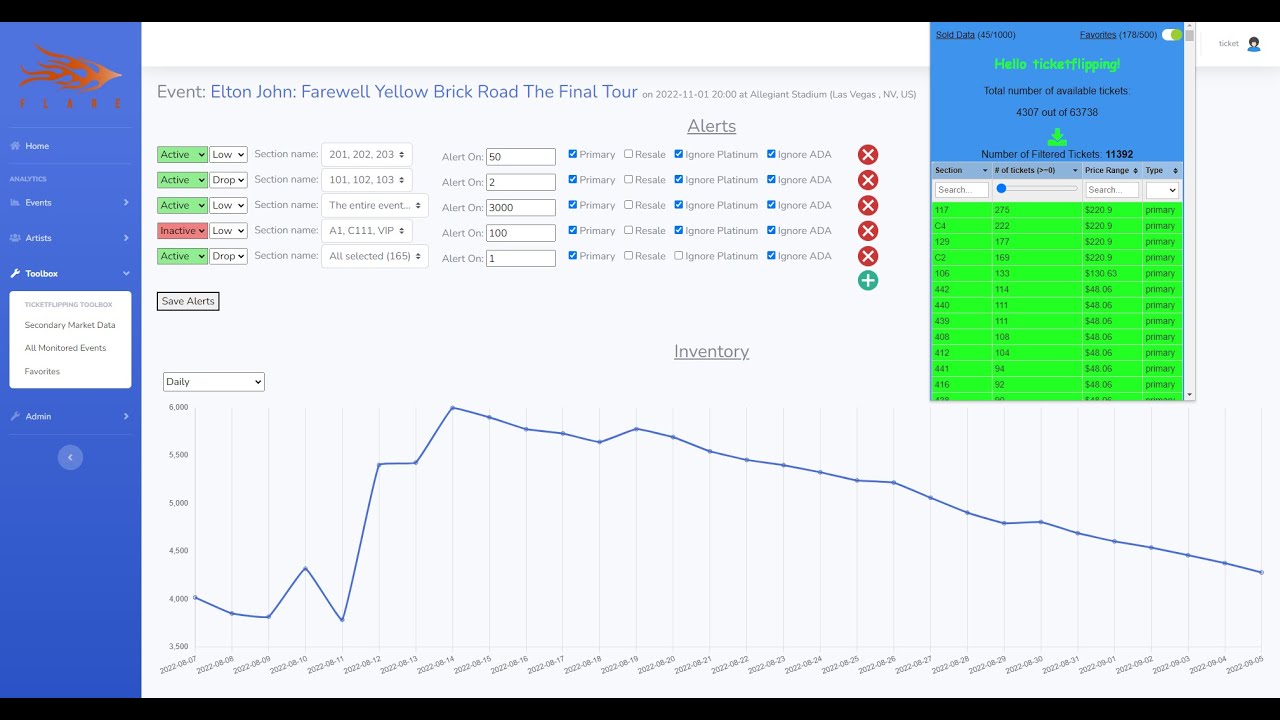
When a scalper platform testifies that it opposes bots, this is the ecosystem it is embedded in. Some tools are fully automated. Others simply give professionals a speed and volume advantage that no fan can compete with unaided. The distinction doesn't matter to the fan who couldn't get a ticket. The bots and assist tools harvest. The scalper browsers run hundreds of sessions at once. The virtual cards create infinite identities. The proxy networks hide them all. The B2B exchanges distribute the inventory. The distribution software broadcasts it everywhere. The Discord networks coordinate the strategy. The barcode tools extract what shouldn't be transferable. Every piece of this infrastructure exists to serve one purpose: getting between fans and the tickets artists intended for them, and extracting a profit at every step. Legislation that only addresses one piece of this chain will be routed around within months. Comprehensive reform is the only answer.

Speculative, or "ghost", tickets are one of the secondary market's most dangerous practices. A seller lists a ticket they don't have, betting they can acquire it before the show.
Scalpers in the secondary market openly describe themselves as "short sellers," borrowing the language of Wall Street investors who bet on stocks they don't yet own. The analogy is intentional: list high now, acquire cheap later, pocket the spread. A scalper lists tickets to a show before it even goes on sale, pricing them high on the excitement of the announcement. They then plan to wait for bots to harvest the actual inventory and buy those tickets on the B2B exchange at a lower price than they already sold them for. The B2B marketplace is where they expect to source their inventory later, at a discount, after they've already collected payment from the fan.
There's even a hashtag scalpers use among themselves: #itpaystowait. The longer they hold off buying the actual ticket, the more profit they make. The fan thinks they have a confirmed ticket. The scalper is still shopping.
The industry knows this is a problem. The leader of the NATB, the National Association of Ticket Brokers, described speculative ticketing to a room full of brokers as "BUY NOW, PROCURE LATER" — to laughter. That is the industry's own language for a practice they publicly call a legitimate consumer service. They've lobbied for a carveout in speculative ticket bans, a so-called "concierge service" exemption. In practice, this is fine print buried at the bottom of a listing page disclosing that the seller doesn't currently hold the ticket. It is not a solution. It is legal cover.
That carve-out does nothing for the fan who flew across the country. Who booked a hotel. Who took their kid to see their favorite artist for the first time. A refund is not a show.
Scalper platforms claim a 1% failure rate on ticket delivery, as if that's reassuring. One percent of a $10 billion industry is $100 million a year in fans who showed up to an event and were turned away at the door because their ticket was never real. That's not a rounding error. That's a policy failure at industrial scale.
You should only be permitted to sell what you already possess. This is not a radical idea. It is the baseline of every other commercial transaction.
* Industry-cited 1% failure rate applied to $10B annual marketFor every bill introduced to protect fans, the secondary market sends professionals to fight it, not as industry lobbyists, but disguised as consumer advocates, fan coalitions, and independent researchers. Understanding who is in the room, and who is paying for them to be there, is essential to understanding why reform is so hard.
Organizations like the Ticket Policy Forum (funded by StubHub, SeatGeek, Vivid Seats), Coalition for Ticket Fairness (funded by ticket brokers), Sports Fans Coalition (spent $42,000 lobbying against a Maryland fan-protection bill alongside scalper platforms), and Chamber of Progress (lists StubHub and Vivid Seats as corporate partners) all claim to represent fans. They do not. Each of them is profiled below.
Consumer Reports is one of the most respected consumer advocacy organizations in the country. It does not accept funding from ticket companies or secondary market platforms. Its positions are independent. Consumer Reports has stood with fans and against predatory scalping practices, and has supported meaningful legislative reform.
Remember that standard as you read what follows. The question to ask about every organization claiming to represent fans is simple: who is paying for them to be in that room?
In Maryland's 2024 ticketing fight, the secondary market coalition spent over $227,000 lobbying against fan protection, more than twice what Live Nation spent, and Live Nation didn't even take a side. That asymmetry is not an accident. It is the strategy.
The secondary market spends millions lobbying nationally, more than the alleged monopoly they claim to be fighting. They have professional lobbyists, proxy consumer groups, and industry-funded research. Artists and fans have none of that. We have a story, a community, and the truth.
Note that Sports Fans Coalition, an organization that presents itself publicly as a grassroots voice for fans, spent $42,000 lobbying against a Maryland fan protection bill, alongside StubHub, Vivid Seats, and SeatGeek. That $42,000 came from the same budget as their fan-facing messaging. They are not alone.
The Ticket Policy Forum is the clearest example because there is no pretense of independence. Its members are openly disclosed: StubHub, SeatGeek, Vivid Seats, TickPick, Gametime, and Events Ticket Center. It is the secondary market's direct lobbying arm, renamed as a policy forum. Its executive director, Brian Berry, testifies in statehouses coast to coast, including New York, presenting himself as a neutral voice for consumers.
Their core positions: oppose price caps, oppose speculative ticket bans, protect the right to resell without restriction. Every position serves one constituency, the platforms that fund them.
The Coalition for Ticket Fairness presents itself as a consumer rights organization but is funded by ticket brokers. Event Tickets Center, a ticket broker, is one of CTF's biggest and longest-running sponsors, alongside the National Association of Ticket Brokers as an allied organization. CTF has retained professional lobbyists from Davidoff Hutcher & Citron to lobby on live event ticketing in New York and at the federal level.
Their legislative positions align entirely with broker industry interests: protecting the right to resell, opposing transfer restrictions, fighting price caps. Most telling: CTF's own website cites the Bradshaw Advisory report as independent evidence that price caps cause fraud, the same report that was commissioned and paid for by StubHub. The circular nature of that is remarkable: the industry funds a study, then a group funded by the industry cites that study as independent research.
Sports Fans Coalition presents itself as a grassroots organization dedicated to putting fans first. On ticketing specifically, their positions, defending the right to transfer tickets without restriction, opposing resale price regulations, align perfectly with scalper industry interests. In Maryland's 2024 ticketing fight, Sports Fans Coalition spent $42,000 lobbying against a bill designed to protect fans, doing so alongside StubHub, Vivid Seats, and SeatGeek. That is documented in Maryland's public lobbying disclosure records.
A "grassroots" organization spending $42,000 lobbying against fan protections, in coalition with the platforms that profit from scalping, is not representing the fans it claims to speak for.
Chamber of Progress describes itself as a center-left tech policy coalition. Its corporate partners include StubHub and Vivid Seats, a fact that Live Nation publicly called out when the Chamber produced a report attacking fan protection legislation as secretly benefiting Ticketmaster.
The Chamber's report framed the secondary market as "the only true source of competition" for Live Nation and urged state lawmakers to pass "resale freedom laws" protecting scalper business models. Chamber of Progress says its corporate partners don't control its positions. But its positions on ticketing consistently favor the platforms that fund it, and consistently oppose the legislation that would protect fans.
Both the National Consumers League (NCL) and the Consumer Federation of America are legitimate organizations with important work across food safety, worker rights, and consumer protection. Neither is a front group in the way others on this list are. They deserve that distinction.
On ticketing specifically, both organizations receive donations from secondary market companies, and their legislative positions on resale rights track closely with industry interests. When organizations with this credibility and history testify in favor of positions that benefit scalper platforms, legislators listen, which is precisely why the industry invests in those relationships. Europe tells a different story: consumer groups there largely do not accept funding from resale platforms, and fan protections in most of Europe are significantly stronger as a result. The funding model matters.
Consumer Reports remains the benchmark. It takes no corporate money from ticket companies, and its positions on ticketing reflect that independence.
This report is the secondary market's primary weapon against price cap legislation. It claims that fraud is nearly four times higher in Ireland and Victoria, Australia, both of which have resale price caps, compared to the UK, which did not have caps at the time of the study. It has been widely cited in legislative testimony across multiple states and countries as independent evidence that price caps endanger consumers.
What it almost never gets mentioned alongside: the report was commissioned and paid for by StubHub International. That is disclosed in the document itself. The authors were hired to reach a conclusion their client needed. This is not independent research. It is a brief.
The methodology doesn't hold up either. The study did not track what Ireland's fraud rates were before the cap was introduced, meaning it cannot establish that the cap caused any change. It simply compared two different countries with different regulatory histories, enforcement environments, and consumer behaviors, then attributed the difference to one variable that served the client's argument.
Most critically: Irish banks, who would see fraud in their transaction data, directly contradict the report's conclusion. Anti-touting campaign FanFair spoke with Ireland's largest banks, who reported that the 2021 price cap did not produce an increase in online fraud. Australian consumer groups said the same. There is no demonstrable independent evidence supporting the Bradshaw report's central claim. When you see it cited as fact in a hearing room, you are watching industry-funded research laundered through a respectable-sounding consultancy name.
In February 2026, directly during the S.8221-A legislative push in Albany, StubHub announced "Access: New York," a $100,000 ticket giveaway for youth sports teams across New York State. It received warm press coverage and positions StubHub as a community benefactor invested in New York's children.
On its face, giving kids access to live events is a good thing. No one is against that. But step back and look at the broader context. This is a company spending millions on lobbyists to preserve a system that allows industrial-scale ticket speculation and price inflation that New York families absorb every day. A six-figure giveaway is a rounding error compared to the scale of profit generated from resale markups and fees.
The announcement was made by Michael DeLoach, StubHub's Global Head of Government Relations, not a community affairs officer, not a philanthropy director. The head of government relations announced a charitable program during an active legislative fight in which StubHub has significant financial interests.
Philanthropy doesn't offset policy. Symbolic generosity shouldn't distract from structural exploitation. If StubHub truly wants to support New York fans, there's a much simpler solution: support the reforms that protect them. Fans deserve fairness, and kids shouldn't be priced out of live events in the first place.
Legislators hear from the secondary market lobbyists every day. They rarely hear from the fans those markets exploit, or the artists who watch it happen. Fill in your details below and we'll draft a personal letter to your specific senator and assembly member. One click sends it.
Your name and ZIP are used only to personalize your letter and find your legislators.
We do not store or share your information.
Thank you for standing up for fans. Every message a legislator receives from a constituent carries real weight — especially when the other side has a $227,000 lobbying budget and you have the truth.
Share this page with other fans to multiply the impact.
In both chambers of the New York State Legislature, companion bills have been introduced to deliver the most significant ticketing reform the state has seen in a generation. In the Senate, Senator James Skoufis introduced S.8221-A. In the Assembly, Assemblymember Ron Kim introduced the companion bill A.8659. Together they represent a bicameral push for comprehensive fan protection. We support the strongest provisions of both bills and urge the legislature to pass them.
In Maryland's 2024 ticketing fight, the secondary market coalition spent over $227,000 lobbying against fan protection, more than twice what Live Nation spent, and Live Nation didn't even take a side. That asymmetry is not an accident. It is the strategy.
The secondary market spends millions lobbying nationally, more than the alleged monopoly they claim to be fighting. They have professional lobbyists, proxy consumer groups, industry-funded research, and years of practice shaping legislation in their favor. Artists and fans have none of that. We have a story, a community, and the truth. We're asking New York to listen to the right side of the room.